Losing a tooth (or several) isn’t just a cosmetic issue. A gap can affect how you chew, how you speak, and how your bite works overtime, it may also contribute to discomfort and changes in your mouth and jaw.
The good news: Alira Smiles offer several reliable ways to replace missing teeth, including dental bridges, dentures, and dental implants. The right choice depends on your mouth, budget, timeline, and long-term goals.
Note: This article is general information and doesn’t replace personalised advice from your dentist. Book an Appointment Today.
Why replacing missing teeth matters ?
When a tooth is lost, people can experience complications such as changes in chewing, speech issues, and bone loss in the jaw area over time.
That’s why dentists often recommend discussing a replacement option sooner rather than later—especially if the missing tooth affects your bite or eating comfort.
Tooth replacement options briefly
Here’s the simplest way to think about your options:
-
- Dental bridge: a fixed tooth (or teeth) supported by neighbouring teeth (or sometimes implants).
-
- Dentures (partial or full): removable teeth replacements; can also be implant-retained for extra stability.
-
- Dental implants: a titanium “root” placed in the jaw that can hold a crown, bridge, or denture.
Option 1: Dental bridges (fixed tooth replacement)
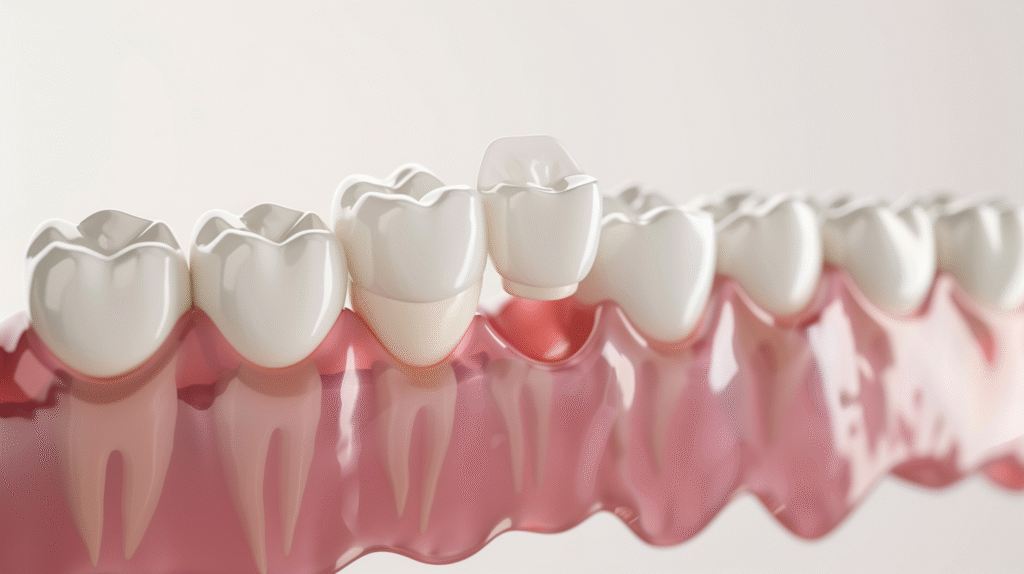
A dental bridge is designed to “bridge” the gap where one or more teeth are missing. Many bridges use crowns on the teeth next to the gap for support.
Common bridge types
-
- Traditional bridge: crowns on both sides support the replacement tooth.
-
- Cantilever bridge: supported on one side only (case-dependent).
-
- Maryland (resin-bonded) bridge: bonded “wings” on adjacent teeth (often for certain front-tooth situations).
-
- Implant-supported bridge: a bridge held by implants instead of natural teeth.
Pros (why people choose bridges)
-
- Fixed (not removable), feels more like natural teeth than a removable appliance for many people.
-
- Often quicker than implants in overall timeline (depends on case).
Considerations
-
- Some bridges rely on adjacent teeth for support, which can affect those teeth and make cleaning under the bridge important.
Option 2: Dentures (partial, full, or implant-retained)
Dentures are removable appliances that replace missing teeth. You may hear:
-
- Partial dentures (some natural teeth remain)
-
- Full/complete dentures (replace a whole arch)
-
- Implant-retained dentures (attach to implants for extra stability)
Pros (why people choose dentures)
-
- Often the most budget-friendly starting point (varies widely).
-
- Non-surgical option (unless you choose implant-retained dentures).
Considerations
-
- Fit and comfort can change over time, and adjustment takes patience.
-
- Cleaning and daily care matter a lot for comfort and oral health.
Denture care basics
Many dentures need to stay moist when not worn, and cleaning routines typically include brushing/rinsing and overnight soaking (based on your dentist’s instructions and product guidance).
Option 3: Dental implants (single tooth, bridge, or denture support)
A dental implant is commonly described as a titanium screw placed into the jawbone that can support a crown, bridge, or denture.
Pros (why people choose implants)
-
- Designed to function like a tooth root and can replace one tooth without relying on neighbouring teeth.
-
- Can support implant bridges and implant-supported dentures for multiple missing teeth.
Considerations
-
- It’s a surgical procedure with potential risks (though complications are uncommon), such as infection, nerve issues, or sinus complications (upper jaw).
-
- The process can take multiple visits and may take months from start to finish in many cases.
How to choose the best option for your missing teeth
A dentist typically looks at:
-
- How many teeth are missing (single vs multiple vs full arch)
-
- Condition of neighbouring teeth (strong enough to support a bridge?)
-
- Jawbone and gum health (especially important for implants)
-
- Timeline (implants can take longer; dentures/bridges may be faster depending on case)
-
- Budget & long-term maintenance (upfront vs ongoing care considerations)
FAQs: Missing Teeth, Bridges, Dentures & Implants
1) What is the best option for missing teeth?
There isn’t one “best.” Bridges, dentures and implants all work well in the right situation. The best option depends on your oral health, jawbone, number of missing teeth, timeline and budget.
2) Are dental implants better than bridges?
Implants may last longer for many patients and don’t rely on adjacent teeth, but they require surgery and often cost more upfront. Bridges can be a quicker fixed option in some cases.
3) How long do dental implants take?
It varies. From planning to final crown, it can take months in many cases. Your dentist will explain what’s realistic for your situation.
4) Do implants hurt?
Some swelling and minor bleeding can be normal after implant placement. Pain levels vary; your clinician will guide pain control and aftercare.
5) Can I get implants if I have bone loss?
Sometimes yes, but it depends on how much bone is available and your overall oral health. Your dentist may assess whether additional procedures are needed.
6) What are partial dentures?
Partial dentures replace one or more teeth and are usually held in place using clasps or attachments to remaining teeth (design varies).
7) What’s the difference between full dentures and partial dentures
Full dentures replace all teeth in an arch; partial dentures replace some teeth when others remain.
8) What is implant-retained dentures?
They’re dentures that attach to implants in the jaw for improved stability compared with conventional dentures.
9) How do I clean and store dentures properly?
Cleaning routines vary by material, but many dentures should be cleaned daily and kept moist when not in use (often soaking overnight) as advised by your dentist.
10) Can I eat normally with a bridge, denture, or implant?
These treatments are designed to restore chewing function, but adaptation differs. Your dentist will advise on what to eat right after fitting and how to adjust over time.
11) Why should I replace a missing tooth if it’s not visible?
Tooth loss can affect chewing patterns, speech, and jawbone over time, even if the gap is at the back.
12) Which option looks most natural?
Implants are often described as the most similar to natural teeth, but modern bridges and dentures can also look very natural when properly designed.
Call Us and Book your Appointment Today.
